
Methodology

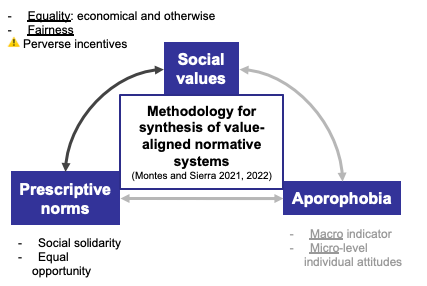
Methodologically, we intend to follow the framework originally presented by the authors in (1)(2) to develop an agent-based social model in which norms corresponding to the rhetoric of equal opportunity and the principle of social solidarity act as enhancers or mitigators of aporophobia. The model will allow to see the effect of the different levels of aporophobia on poverty levels.

While it has been acknowledged that aporophobia has psychological and evolutionary elements, based on the human search for reciprocity (3), there are cultural and economic factors that aggravate the phenomenon. The rhetoric of equal opportunity (4), the meritocratic principles in an era of growing inequality (5), the distorted perception of social mobility (6) and the blame attached to poverty within the capitalism social recognition order (7) are key concepts in the simulation.

(1) Montes, N. Sierra, C. (2021). Value-Guided Synthesis of Parametric Normative Systems. AAMAS. 
(2) Montes, N. Sierra. C. (2022). Synthesis and Properties of Optimally Value-Aligned Normative Systems. JAIR
(3) 
Cortina, A. (2017). Aporophobia el rechazo al pobre. Paidós.
(4)  Sandel, M.J. (2020). The Tyranny of Merit. Penguin Random House. 
(5) Chancel, L. Piketty, T. (2021). Global Income Inequality 1820 – 2020. The persistence and mutation of extreme inequality. Journal European Economic Association.
(6) Alesina, A., Stantcheva, S., & Teso, E., (2018). Internerational Mobility and Preferences for Redistribution. American Economic Review 108(2), 521 – 554. 
(7)  Fraser, N.  Honneth. A. (2003). Redistribution or recognition?  A political – philosophical exchange. Verso books.

The research leverages on the team members’ recently published methodology for synthesis of value-aligned normative systems
and the state-of-the-art in social sciences on approaches for discrimination and economic development.